Wusthof Classic vs Zwilling Pro: The German Knife Decision
As an Amazon Associate, I earn from qualifying purchases. Steel and Strop is reader-supported — links to Amazon below use my affiliate tag, at no extra cost to you.
Don’t decide this one by steel — both brands use their own proprietary stainless at a nearly identical 56 to 58 HRC, and you won’t feel a meaningful performance gap between them. Decide it by blade profile instead. Wusthof’s Classic has a flatter, more centered curve that suits push-cutting and general chopping. Zwilling’s Pro line curves up more toward the tip, which rewards a rock-chop motion but leaves less flat edge on the board.
This is one of the oldest rivalries in kitchen cutlery, and it survives because both companies genuinely make excellent, comparable knives — the argument was never really about quality.
The steel isn’t where they differ
Both Wusthof Classic and Zwilling Pro are fully forged from a single piece of German stainless, run at a moderate 56 to 58 HRC. That hardness is a deliberate choice for this category: it trades outright edge retention for toughness and ease of maintenance, which is exactly what you want in a knife that’s going to see daily, sometimes rough, home kitchen use for a decade or more. Neither brand is trying to compete with Japanese VG-10 or SG2 on edge-holding — that’s simply not the design brief here.
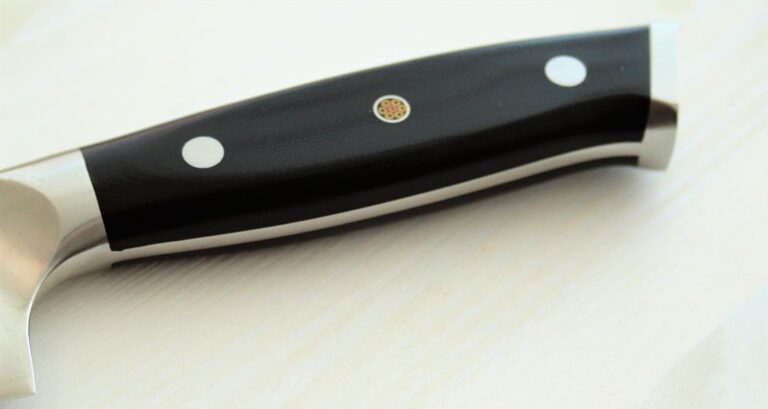
Both are full tang with a full bolster running from spine to edge, riveted handle scales, and a genuinely reassuring, substantial feel in the hand. If you picked either knife up blind and were only told to judge the steel, you’d struggle to tell them apart.
At a glance
| Spec | Wusthof Classic | Zwilling Pro |
|---|---|---|
| Steel | Proprietary German stainless, ~56–58 HRC | Proprietary German stainless, ~56–58 HRC |
| Construction | Forged, full tang, full bolster | Forged, full tang, full bolster |
| Blade profile | Flatter, centered — versatile technique | Curved up toward tip — rock-chop focused |
| Rock-chopping | Good | Excellent — the profile is built for it |
| Push/tap cuts | More flat edge to work with | Less flat contact with the board |
| Price tier | Mid-range | Mid-range |
Why blade profile is the actual decision
Rock-chopping — keeping the tip down and rocking the heel up and down through herbs, garlic, or onions — is the default technique for a lot of home cooks, and Zwilling’s more pronounced curve toward the tip is built specifically to reward it. Wusthof’s flatter profile handles rock-chopping fine too, but it comes into its own with push cuts and tap chops, where you’re moving the whole blade forward through the food rather than rocking in place — think slicing through a stack of vegetables in one motion.
Neither technique is “correct.” Most home cooks use some mix of both without thinking about it, which is exactly why this decision is worth making with a knife in your actual hand rather than from a spec sheet, if you can manage it at a kitchen shop or a friend’s house.
The full bolster trade-off both knives share
Both lines run a full bolster from spine to edge, which feels reassuring and substantial when you grip the handle normally. The trade-off, shared equally by both knives, is that a full bolster can dig into your index finger if you use a pinch grip — holding the blade itself just above the handle, which is how a lot of more experienced cooks and professional chefs actually hold a knife. If you already pinch-grip and find it uncomfortable on one, expect the same from the other; this isn’t a Wusthof-versus-Zwilling difference, it’s a shared design decision in this style of knife.
Who should buy which
Buy the Wusthof Classic if you do a mix of push cuts and rock chopping, or you’re not sure yet which technique you favor. Buy the Zwilling Pro if you already know you’re a committed rock-chopper — herbs, garlic, onions, that steady rocking motion — and want a profile built specifically for it.
Frequently asked questions
Is Wusthof Classic better than Zwilling Pro?
Not objectively — the steel is nearly identical in both. The better knife for you depends on whether your cutting technique favors a flatter edge (Wusthof) or a more curved, rock-chop-focused profile (Zwilling).
Do Wusthof and Zwilling use the same steel?
Not literally the same alloy, but functionally very similar — both are proprietary German stainless blends run at a comparable 56 to 58 HRC.
Which is more comfortable with a pinch grip?
Neither has a clear advantage — both use a full bolster that can feel similar to a pinch grip user on either knife. If pinch-grip comfort is a priority, look at half-bolster or bolster-free lines from either brand instead.
Steel and Strop tests and compares kitchen knives and sharpening gear. Steel hardness and construction details reflect manufacturer specifications and consistent third-party comparison testing.