Guided System vs Freehand Whetstone: Which Should You Learn?
As an Amazon Associate, I earn from qualifying purchases. Steel and Strop is reader-supported — links to Amazon below use my affiliate tag, at no extra cost to you.
A guided system gets you to a consistent, usable edge faster, with far less frustration in the first few sessions — that’s the whole point of the clamp and the angle guide. Freehand sharpening takes longer to learn and produces worse early results, but once mastered it’s faster per sharpening, needs no extra equipment, and works on any blade shape a clamp might struggle with. Beginners are usually better served starting guided; the “should I learn freehand eventually” question is a separate one worth answering honestly for yourself.
This isn’t really a question of which method is objectively better — both produce excellent edges in skilled hands. It’s a question of what kind of learning curve you’re willing to sign up for.
What a guided system actually buys you
Systems like the Work Sharp Precision Adjust or Edge Pro Apex clamp the blade and hold the sharpening angle mechanically, removing the single hardest skill in freehand sharpening — keeping the angle steady, stroke after stroke, without the stone or your hand drifting. That mechanical consistency is why a genuine beginner can produce a usable, even edge on their very first attempt with a guide, something that reliably takes freehand sharpeners weeks or months of practice to achieve.
At a glance
| Factor | Guided system | Freehand |
|---|---|---|
| Time to first usable edge | Fast — often the first session | Slow — weeks of practice typical |
| Consistency for beginners | High, mechanically enforced | Low until angle control develops |
| Equipment cost | Extra — clamp/guide plus stones | Lower — just stones |
| Speed once mastered | Moderate — setup takes time | Fast — no clamping step |
| Works on any blade shape | Limited by clamp design | Yes — full flexibility |
What freehand sharpening actually costs you upfront
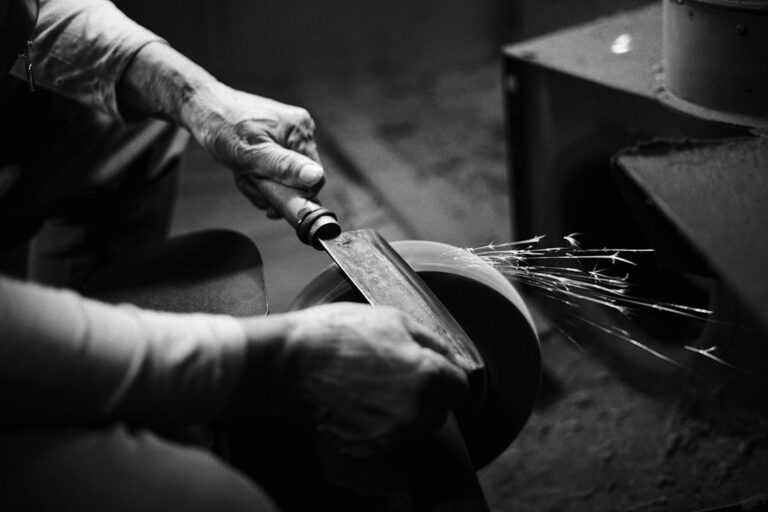
Learning to hold a consistent angle by feel alone is genuinely difficult, and early attempts commonly produce an uneven edge — sharp in spots, dull in others — until muscle memory develops. There’s no shortcut around this practice period; it’s the reason so many people give up on freehand sharpening after one frustrating attempt and never try again, even though the skill itself isn’t actually beyond reach with enough repetition.
Why experienced sharpeners often prefer freehand anyway
Once the angle-holding skill is built, freehand sharpening is faster in practice — no clamping, no adjusting a guide for a different blade width or curve, just the knife and the stone. It also handles knife shapes a clamp can struggle with, like a curved santoku belly or an unusually thin Japanese blade, without needing a specialized attachment. That flexibility is exactly why serious hobbyists who started on a guided system often eventually move to freehand, not because the guide failed them, but because freehand becomes more efficient once the hard part is already learned.
The honest recommendation for most people
Start guided if getting a genuinely sharp knife with minimal frustration matters more to you than the process itself. Learn freehand specifically if you expect to be sharpening for years, want the flexibility to handle any blade shape without a special guide, or simply find the skill itself satisfying to build — plenty of people start with a guided system and pick up freehand skills gradually afterward, rather than treating it as an either-or choice made once.
Frequently asked questions
Is freehand sharpening better than a guided system?
Not objectively — both produce excellent results in skilled hands. Freehand takes longer to learn but offers more flexibility and speed once mastered.
Should a total beginner start with a guided system?
Generally yes — it produces a usable edge much faster and with far less frustration than learning freehand from scratch.
Can you switch from a guided system to freehand later?
Yes, and it’s a common path — many people start guided to get comfortable with sharpening basics, then transition to freehand once they’ve built some feel for it.
Steel and Strop tests and compares kitchen knives and sharpening gear. This comparison reflects manufacturer specifications and consistent, long-running owner and enthusiast reporting on both approaches.