Gyuto vs Santoku: Which One Should Actually Live on Your Board?
As an Amazon Associate, I earn from qualifying purchases. Steel and Strop is reader-supported — links to Amazon below use my affiliate tag, at no extra cost to you.
If you can only own one knife, make it a gyuto — its longer, curved blade handles rock-chopping, slicing, and larger cuts of meat and vegetables in a way a santoku simply isn’t shaped for. A santoku earns its place as a second knife, or as a first knife for someone with smaller hands or a smaller cutting board who mostly does straight up-and-down chopping rather than rocking the blade.
Both get marketed as “the” essential Japanese kitchen knife, which glosses over the fact that they’re built for genuinely different motions.
The shape tells you the job
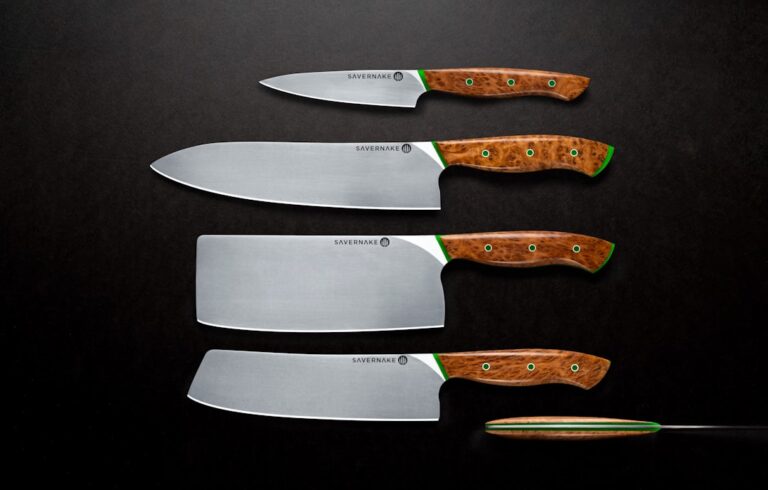
A gyuto is the Japanese answer to a Western chef’s knife — typically 210 to 240mm, with a pointed tip and a curved belly that lets you rock the blade through herbs and onions the same way you would with a European knife, while also handling long push cuts and piercing tasks the flat-edged designs can’t. It’s the closest thing to a true all-rounder in the Japanese knife world.
A santoku is shorter, usually 165 to 180mm, with a flatter edge and a rounded or sheep’s-foot tip instead of a point. It’s built around push-cutting and a straighter up-and-down chopping motion rather than rocking, and its shorter length and lighter weight make it comfortable for smaller hands or a smaller kitchen. What it gives up is reach and rocking capability — piercing a squash or breaking down a larger protein is noticeably harder with a santoku’s blunter profile.
At a glance
| Spec | Gyuto | Santoku |
|---|---|---|
| Typical length | 210–240mm — more reach | 165–180mm — more compact |
| Tip shape | Pointed — good for piercing, detail work | Rounded/sheep’s-foot — no real point |
| Best technique | Rock-chopping and push cuts both | Push cuts, straight chopping |
| Versatility | Closest thing to an all-rounder | Great for veg-heavy, lighter prep |
| Best for | A single do-everything knife | Smaller hands, smaller boards, second knife |
Why “which one should live on your board” has a real answer
If you’re only buying one Japanese knife to replace a Western chef’s knife entirely, the gyuto’s combination of a point, a curved belly, and enough length to handle larger produce or a bigger cut of protein makes it the more complete tool. A santoku will handle the bulk of everyday vegetable and protein prep just fine, but you’ll notice its limits the moment you need to pierce something, break down a whole chicken, or work through something that needs a bit more blade length to get through in one pass.
Where santoku genuinely wins
Smaller hands, smaller kitchens, and cooks who do a lot of straight-down chopping rather than rocking the blade often find a santoku simply more comfortable day to day — it’s lighter, shorter, and easier to maneuver in a tight space. It’s also a very sensible second knife alongside a gyuto, handling quick vegetable prep while the gyuto stays reserved for bigger jobs.
Who should buy which
Buy a gyuto if you want one knife capable of handling nearly everything a home kitchen throws at it. Buy a santoku if you have smaller hands, a smaller cutting board, or you already know your prep style leans toward push-cutting rather than rocking the blade.
Frequently asked questions
Can a santoku replace a chef’s knife entirely?
For lighter, vegetable-heavy prep, largely yes. For larger cuts of meat, piercing tasks, or rock-chopping technique, its shorter length and blunter tip are real limitations.
Is a gyuto harder to use than a santoku?
Not harder, just longer and slightly heavier, which can feel less immediately familiar to someone used to a shorter blade. Most people adjust within a few uses.
Which is better for vegetables?
Both handle vegetables well. A santoku’s flatter edge suits straight push-cuts through veg slightly better, while a gyuto’s curve is more versatile if you’re also cutting meat or larger produce.
Steel and Strop tests and compares kitchen knives and sharpening gear. Blade geometry and technique guidance reflect standard, widely documented Japanese knife design conventions.